
The rapid spread of the new coronavirus puts everyone in danger. From the beginning of January, it spread mainly in China, and then suddenly soared in Italy and Iran, spreading rapidly all over the world in two months. Obviously, this has become a big problem that we human beings need to face together. However, the social problems caused by the spread of new coronavirus, the response methods of different countries to new coronavirus, and the communication between many different cultures also give us a lot of topics worthy of discussion. As a Chinese in the UK and an Asian in Europe, I intend to take China and Germany as an example, writing this feature to share some of my findings and ideas about the new coronavirus as objectively and neutrally as possible.

What is Coronavirus?
Coronavirus is a new illness which is highly infectious and can be transmitted through air, especially in the lungs of patients. It causes pneumonia. The incubation period is about 14 days, usually around 3 ~7 days. Patients can have symptoms such as dry cough, fever, fatigue. Because of the strong infectivity of the disease, the patients need to be treated and isolated in time to avoid infecting others.

Up to now (19th Mar, 2020), Coronavirus has infected about 220000 people, nearly 9000 of whom have died.
In China…
As the first country to find new crown cases, the Chinese government plays a very important role in the fight against the new crown virus. During the spread of the epidemic, the Chinese government mobilized human and resources from all regions, even the military to Wuhan for support. This also reflects a feature of China in dealing with emergencies – gathering resources.
Since 10 a.m., Jan 23rd. Wuhan has been under lockdown to contain the spread of the disease. The next day, the first batch of medics from outside Hubei Province in China was assigned to help Wuhan. And 450 military medics also arrived that night.
“The Chinese people are now fighting a very serious battle against the epidemic. The people’s safety and health always come first, it is the country’s most important work for now.” Chinese President Xi Jinpin spoke in 24 Jan.
As Xi called for the coordinated approach in prevention and control work. More and more resources for treatment, prevention and protection send to the front line of the battle against epidemic. The most impressive one is the Huoshenshan and Leishenshan hospital was both built and put into use in 10 days and 46 designated and 14 temporary hospital provided around 20 thousands bed.
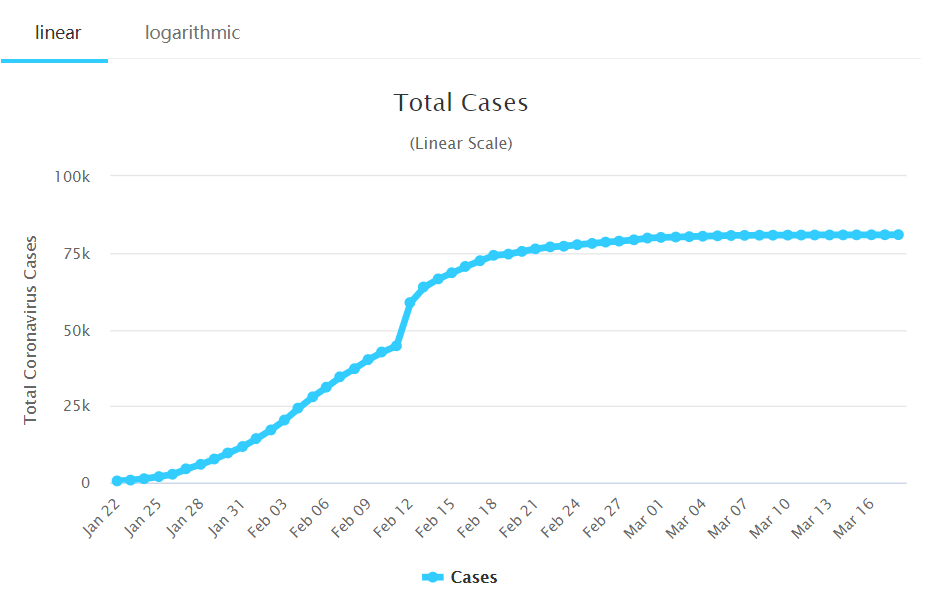
This series of measures have solved the problem of scarce medical resources. After making the most of people’s beds and medical resources, the Chinese government focused on the plan of closing the city. Nearly 40 thousands volunteers have been sent to communities in various regions in order to implement the plan of closing the city, providing local people with services such as temperature measurement and virus detection. At the end of February, China finally reached a cure for more than 40 thousands coronavirus cases, the first time that more patients have been discharged than infected. The cumulative number of recover patients hit around 40 thousands, exceeding the number of confirmed cases for the first time. In March 7th, no local transmitted coronavirus case was reported on the Chinese mainland outside of Hubei Province for the first time. This basically shows that China’s fighting against the epidemic is near to get successful. To some extent, this has bought time for the world to fight against the coronavirus.

In Germany…
Germany’s treatment of the coronavirus is in fact another successful route. After an outbreak in China, the response of different countries to the virus usually determines the impact of the virus on the country. Italy is one of the countries that are far away from China that have a more optimistic attitude towards the spread of the epidemic, which makes them appear unprepared when the virus comes quickly. The number of confirmed cases in Italy doubled daily in early March. There is no way for Italy to continue to try to learn from the management experience previously used by China, to gradually block cities, and to block the country on March 9, but until now, the situation in the country is still not optimistic.
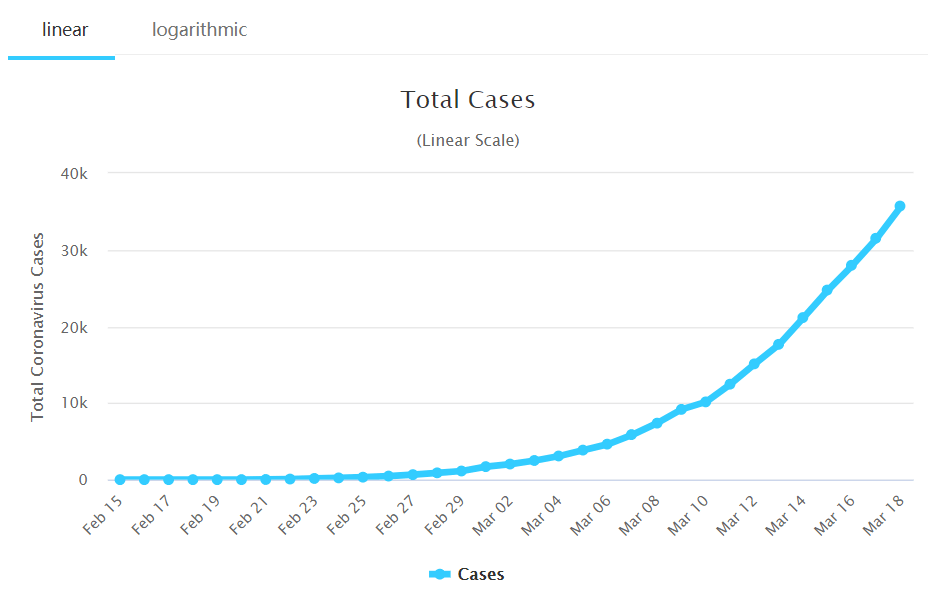
On March 12, the number of confirmed cases officially exceeded 2000 in Germany. In the days before that, the number of people doubled every day. But the majority of the people are still in normal activities.
On March 10, an audience debate was held on Bayern radio. The topic of the debate was: should we cancel the large-scale event now?
“Just go home and wash your hands. Why panic? If all the activities are cancelled, what’s the point of our life? ” Voices like this dominate the debate.
On March 11, Bayern radio opened an expert Q & a session on the new coronavirus. A mother asked: she is very worried, can she let her children stay at home during this period of time without going to class?
The expert replied without hesitation: This is not allowed. Whether schools are closed or not is determined by the state health and education departments. If parents leave their children at home without permission, they may also be fined for obstructing their children’s education.
When you see these situations, as people who have experienced China’s fight against the epidemic, it seems a little inconceivable. Obviously it is time to improve the defense. But in fact, Germany is the country with the lowest mortality rate. How did they do it?
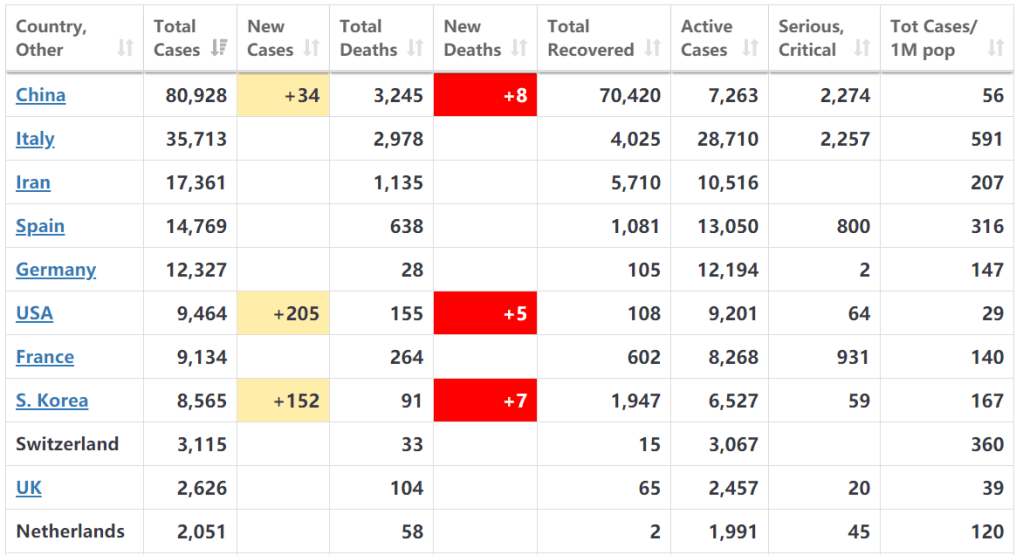
Late February in Germany, after a large amount of Italian cases. German have realized that the outbreak is inevitable. With Germany’s population and resources, only when the number of infected people is small can close tracking of the source of infection be carried out, that is, similar to China’s method. Once there are more than 100 people infected, the investment in each infected person will be very difficult to achieve. After the outbreak became serious, Germany adjusted its strategy to fight to the disease according to the experience from Europe and China.
As a result, the new coronavirus is spreading rapidly in Germany, but hospitals in Germany do not accept light patients, even if the hospital still has a location. This is a lesson learned from China’s lack of hospital resources before January 22, which exacerbated the injured population. Once all the people are in the hospital, not only do they infect each other, but more importantly, the seriously ill patients are more difficult to get treatment after the collapse of the medical system, and the death rate will soar.

Insisting such a strategy, as long as there is no shortage of medical resources, severe patients will be treated accordingly, light diseases can heal themselves, and Germany will greatly reduce the mortality rate.
What can we learn?
In short, China has adopted a solution with Chinese characteristics in the face of coronavirus, relying on the coordination of various regions to turn the tide. It is a kind of “problem solving”. Germany has used a rigorous method with German characteristics to curb the spread speed of the virus to ensure the normal medical system. It is a kind of “damage control”. Nowadays many countries are in trouble with the coronavirus, in addition to their own economic and demographic factors, sometimes the bigger problem is that they have not found a set of solutions in line with their own national conditions.
In addition, China and Europe have not only huge differences in national conditions, but also cultural differences. In China, people’s attitude towards living is more obvious. There is an old saying “living bad is better than dead”. At the same time, most of the Chinese also have a sense of overall situation and collective cooperation. This will lead to 1.4 billion people obeying the order of the state and staying at home for two months. It’s a miracle.
But there is more yearning for freedom in European values. Restricting people’s activities for two months probably even make people feel that life is not as good as death for some people. What’s more, this generation in Germany is basically living a relatively stable and prosperous life, which makes them full of security and calmer towards disasters.
The epidemic is a window through which we can have a chance to glimpse the most real side of a country and its people. In this era of intensive global information and culture exchange, we can learn from each other and learn from each other through epidemic situation. This is one of the enlightenment brought to us by coronavirus.
 Football Collections